
Memantine and ketamine are not the same.
Yes, they are both NMDA receptor antagonists.
But that shared label often obscures major differences in affinity, binding duration, receptor specificity, and clinical effects.
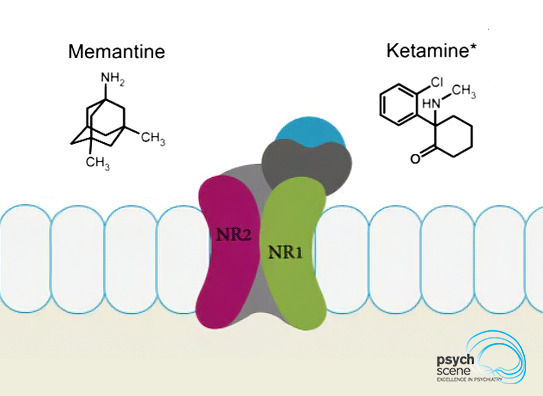
The key point here is that receptor labels can be too broad.
Two drugs can act at the same receptor system and still behave very differently.
Memantine modulates excessive NMDA activity while preserving normal signalling.
Ketamine produces a broader NMDA blockade with a different clinical profile.
Let’s start with memantine’s receptor behaviour.
Memantine is a low-affinity, voltage-dependent, non-competitive NMDA receptor antagonist.
That combination matters because memantine is not designed to erase glutamate signalling.
It is designed to limit excessive NMDA activity.
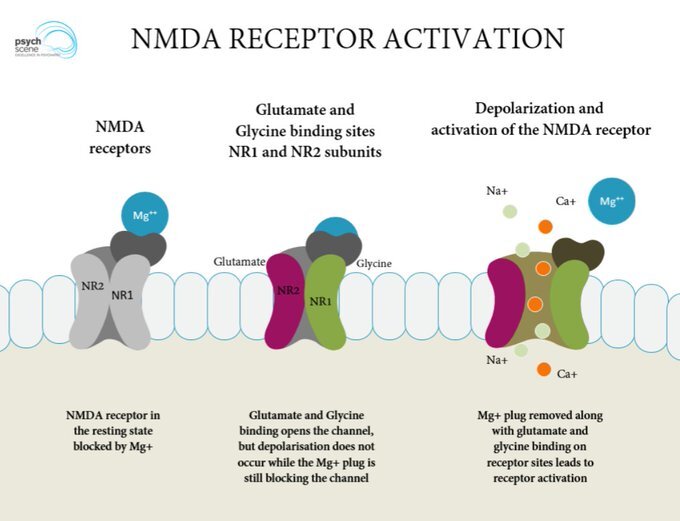
Glutamate is essential for the brain.
It supports:
- learning
- memory
- synaptic transmission
- neuronal plasticity
The problem is not glutamate itself. The problem is prolonged NMDA receptor activation and sustained calcium influx. Memantine works at that point of excess. When glutamatergic activity is excessive, memantine antagonises prolonged calcium influx through the NMDA channel. But during normal physiological signalling, it can dissociate, normal transmission can continue, location sharpens the mechanism. Synaptic NMDA receptor activation is linked with neuronal health. Chronic extrasynaptic NMDA receptor activation is linked with neurotoxicity. Memantine preferentially inhibits extrasynaptic NMDA receptors.
That is the key memantine profile:
- reduce pathological NMDA activity
- preserve normal synaptic signalling
- limit excitotoxicity
- avoid broad receptor disruption
This is why its mechanism is closer to selective modulation than blunt blockade.
Ketamine behaves differently.
It inhibits both synaptic and extrasynaptic NMDA receptors.
It is also less selective for NMDA receptors, with activity at muscarinic, monoaminergic, and opioid receptors.
That broader receptor footprint changes the clinical picture.
Binding duration adds the final distinction.
Memantine has a favourable off-rate from the NMDA receptor channel.
Too slow, and it could accumulate and interfere with normal neurotransmission.
Too fast, and it may be ineffective.
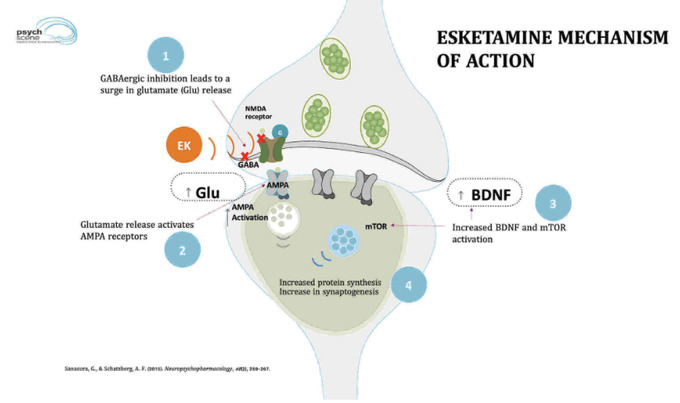
Ketamine binds to NMDA receptors for longer periods than memantine.
That longer binding is linked with more persistent effects on pain and antidepressant activity.
It may also help explain ketamine’s higher sedative and psychotomimetic effects.
Memantine is not simply a ‘weaker’ ketamine.
Its profile depends on:
- low affinity
- voltage dependence
- extrasynaptic preference
- preservation of normal signalling
- favourable off-rate
Same receptor label.
Different pharmacology.
For more evidence-based psychiatry insights like this, join the Psych Scene newsletter.
We share clinical frameworks, research updates, diagnostic explainers, and practical resources designed to support mental health professionals in practice.