
A real-world 2025 EEG study in bipolar depression patients reveals a cascade of changes across brain rhythms, complexity, and excitation-inhibition (E/I) balance.
Let’s break it down:
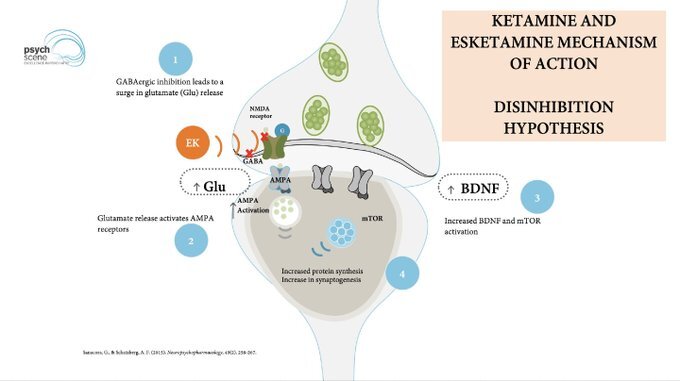
Ketamine, a dissociative compound, shows promise in treating mood disorders, including treatment-resistant depression (TRD) and bipolar disorder (BD).
Despite its therapeutic potential, the neurophysiological mechanisms underlying ketamine’s effects are not fully understood. (Agnorelli, C., et al, 2025).
Oscillatory activity:
Ketamine reduced theta (θ), alpha (α), and low beta (β) power while increasing low gamma (γ), consistent with cortical disinhibition via NMDA antagonism on GABAergic interneurons.
Translation: The brain’s usual slow, calming rhythms were dampened and fast, stimulating activity ramped up.
This likely reflects a release of inhibitory control.
Spectral slope flattening
The slope of the EEG power spectrum above 20 Hz flattened, indicating a shift in E/I balance toward excitation.
Translation: The brain’s rhythm becomes less steady and more noisy. High-frequency activity dominates, indicating a more chaotic state.
Entropy and complexity
Global signal entropy increased, especially in high beta and gamma bands suggesting heightened informational complexity. It decreased in slower frequencies.
Translation: The brain became more unpredictable and dynamic-especially in fast-processing regions.
Rhythms, slope, and entropy are linked
These three metrics shift together, pointing to a shared underlying mechanism.
- oscillatory power +
- spectral slope +
- entropy
Translation: Ketamine doesn’t just tweak one system, it rewires the whole pattern of brain communication.
Dissociation effects unclear:
EEG changes did not consistently correlate with CADSS-measured dissociation; some weak associations (e.g., δ power and derealisation) were not robust.
Translation: While the brain clearly shifts, our current dissociation scales may miss what patients are actually experiencing under ketamine. Ketamine pushes the brain into a globally excited, complex, high-frequency state.
This may be key to both its antidepressant effects and its strange, dissociative experience, but our tools to measure the latter might need rethinking.
Time course matters: The acute, transient excitatory shift may support antidepressant effects, but sustained over-excitation is not adaptive (insomnia, anxiety, mood elevation).
In bipolar depression, activation risk is higher. Monitor for hypomania/mania, agitation, and sleep reduction; consider spacing doses and ensuring mood-stabiliser cover.
Buy Ketamine | Ketamine dissociation mechanism | Buy Spravato